
About the Urhobo Historical Society
Inaugurated on August 29, 1999, in New York City, USA, by a group of Urhobo scholars and professionals in the United States, the mission of the Urhobo Historical Society (UHS) is to serve and promote Urhobo history and culture. With a population of approximately 4 million people, Urhobo is arguably the largest ethnic nationality in Nigeria’s Western Niger Delta region. Its history and culture are intertwined with those of its ethnic neighbors in this region. In serving Urhobo history and culture, therefore, UHS’s efforts include studying and analyzing Urhobo’s relationships with its neighbors, as well as the environmental problems of the Niger Delta region. In 2014, UHS moved its headquarters from the United States to Okpara Inland in Ethiope East LGA of Delta State in Nigeria to be closer to, and better serve its people.
The Urhobo people have a distinct history, language, and culture which need to be studied, documented, and preserved. Relative to other larger ethnic nationalities in Nigeria, such as the Hausa, Yoruba, Igbo, and Fulani, Urhobo history and culture have not received the needed attention and support from the federal and state governments. The responsibility for studying, documenting, and preserving Urhobo history and culture rests on the efforts of individuals and groups like the UHS. The activities of UHS include but are not limited to the following:
1. Hosting of two websites (https://www.waado.org/ and https://urhobodigitallibrarymuseum.com/home/ to promote Urhobo history and culture.
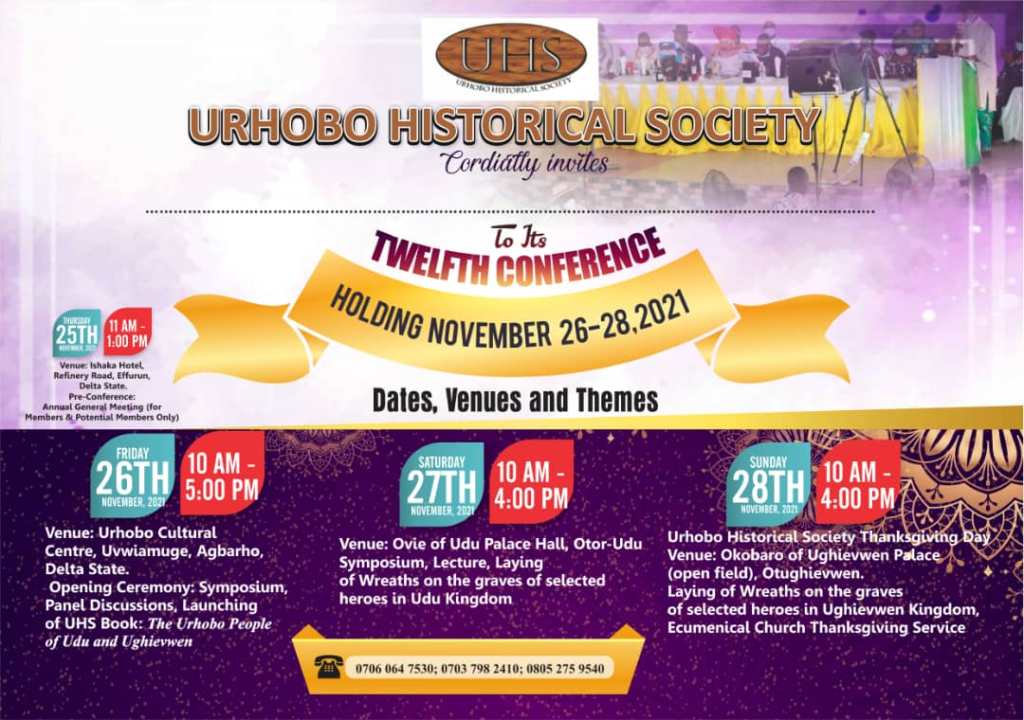
2. Organizing Annual Conferences and General Meetings for presentation and discussion of papers and research work on Urhobo history and culture, review of UHS activities and discussion of policy issues affecting the Urhobo people. The conferences bring together intellectuals and scholars, both Urhobos and non-Urhobos, who are interested in advancing the study of Urhobo history and culture. So far, twelve annual conferences and general meetings have been as follows:
| Conference | Dates | Venue/Location |
| First | November 3-5, 2000 | Niagara Falls, Canada |
| Second | November 2-4, 2001 | Parsippany, New Jersey, USA |
| Third | November 1-3, 2002 | Goldsmith College of London University, London, England |
| Fourth | October 31 – Nov 2, 2003 | Goldsmith College of London University, London, England |
| Fifth | October 29-31, 2004 | PTI Effurun & Agharha-Otor, Delta State, Nigeria |
| Sixth | October 20-23, 2025 | PTI Effurun & Sapele, Delta State, Nigeria |
| Seventh | November 3-5,2006 | PTI Effurun & Agbarho, Delta State, Nigeria |
| Eight | November 26-29, 2009 | PTI Effurun & Ovu, Delta State, Nigeria |
| Ninth | November 12-16, 2014 | PTI Effurun & Olomu, Delta State |
| Tenth | November 20-22, 2015 | PTI Effurun & Evwreni Delta State, Nigeria |
| Eleventh | May 18-20, 2018 | PTI Effurun, Orogun, Agbarha, Ughele & Ogor, Delta State Nigeria |
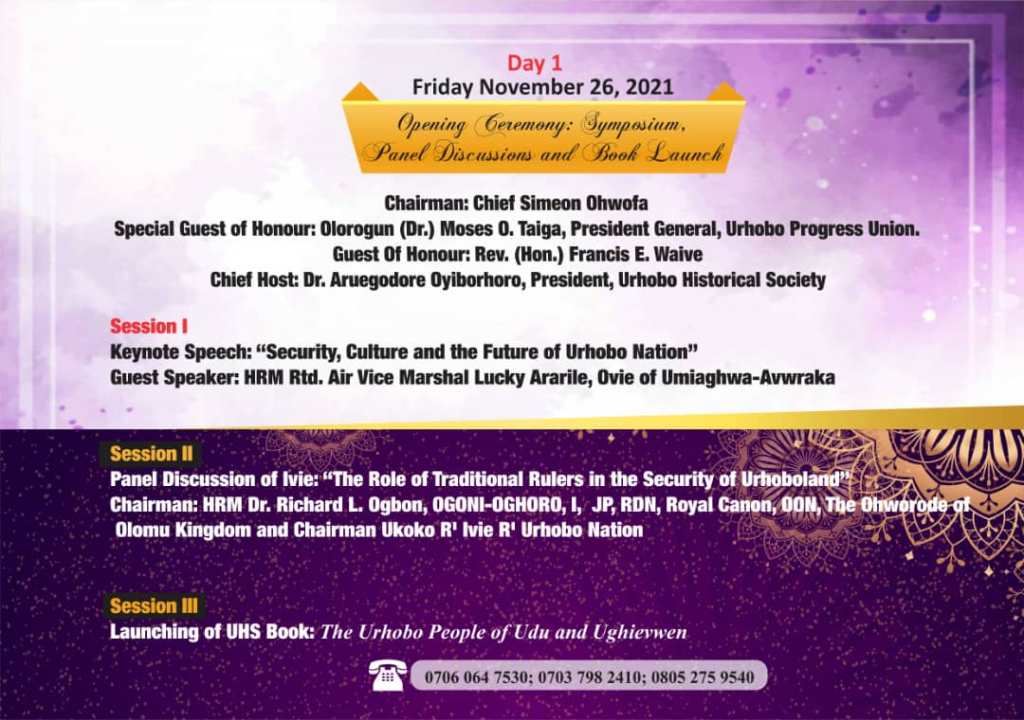
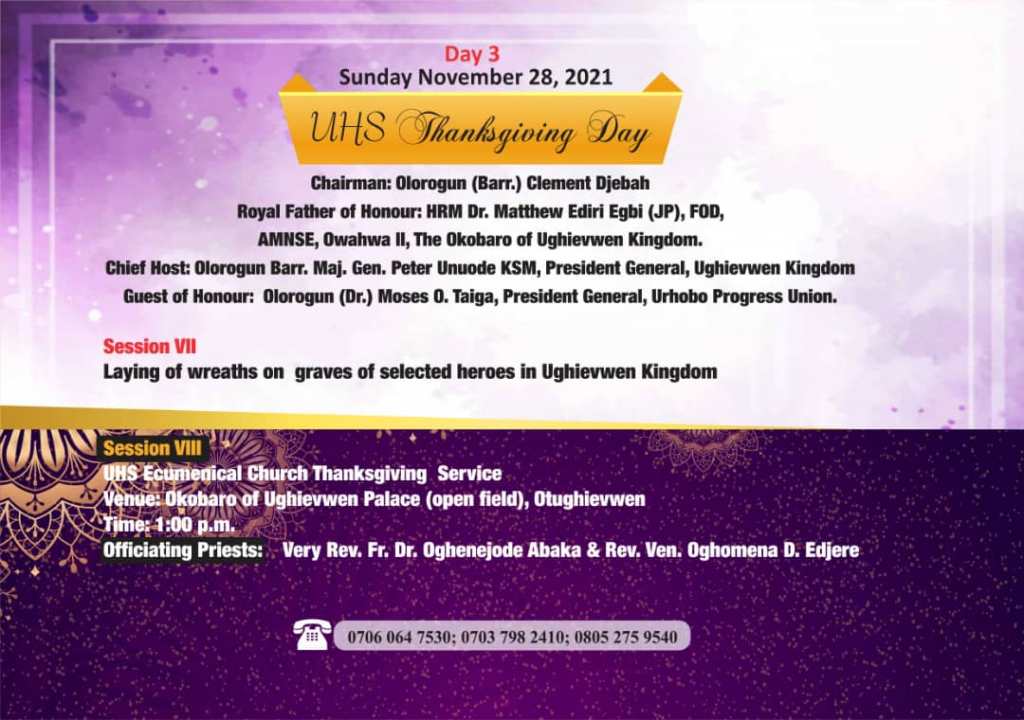
| Twelfth | November 26-28, 2021 | Urhobo Cultural Centre, Uvwiamughe, Otor-Udu & Otughievwen, Delta State, Nigeria |
Now, in 2024, the Urhobo Historical Society returns to New York City, where the unfolding journey of the Society and its remarkable contributions to the Urhobo Nation, began.
3. Providing and disseminating information on Urhobo history and culture as well as other issues and developments in Urhoboland through its publications. Some of the books that have been published by the UHS include:
- Warri City and British Colonial Rule in the Western Niger Delta. UHS Monograph #1, Edited by P. Ekeh, (2004)
- Studies in Urhobo Culture. UHS Monograph #2, Edited by P. Ekeh (2005)
- History of the Urhobo People of the Niger Delta. UHS Monograph #3 Edited by P. Ekeh (2006)
- T.E.A. Salubi: Witness to British Colonial Rule in Urhoboland and Nigeria. UHS Monograph #4 Edited by P. Ekeh (2008)
- Olomu and Development of Urhoboland and the Western Niger Delta. UHS Monograph #5, Edited by P. Ekeh, O. Edevbie and P. Ishiaka (2012)
- The Urhobo People of Udu and Ughievwen, UHS Monograph #6, Edited by O. Edevbie (2022)
4. Issuing position papers and offering advice on policies and critical issues affecting the Urhobo people. Examples include Towards Formulating an Urhobo Agenda (2005) and “Why Urhobo Historical Society is Opposed to Delta State Government’s Attempt to Control Urhobo Culture and Create “Kingdoms” in Urhoboland. (2008).
5. Publishing an electronic Quarterly Newsletter/Magazine with recent and upcoming events and activities of UHS and other recent events/activities or affecting the Urhobo people. UHS also hosts the UHS OPEN FORUM WhatsApp Platform for information sharing and discussions by members.
6. Holding seminars and training sessions at UHS Headquarters at Okpara Inland, Delta State, Nigeria.
7. Assist in managing private Scholarship Funds/Programs established by its members, such as the Chief Mukoro Mowoe Research Fellowship and the Olorogun James Amudiaga & Mrs. Rhoda Mowoe Scholarship Funds, the Peter Ekeh Memorial Scholarship program, and Jormom Egi Scholarship fund.
UHS current operations are funded through contributions by members of its Editorial and Management Committee (EMC) and Board of Trustees of its Endowment Fund, membership dues, sale of its publications, and donations and sponsorship by friends of UHS.

 Digital Library and Museum of Urhobo History and Culture
